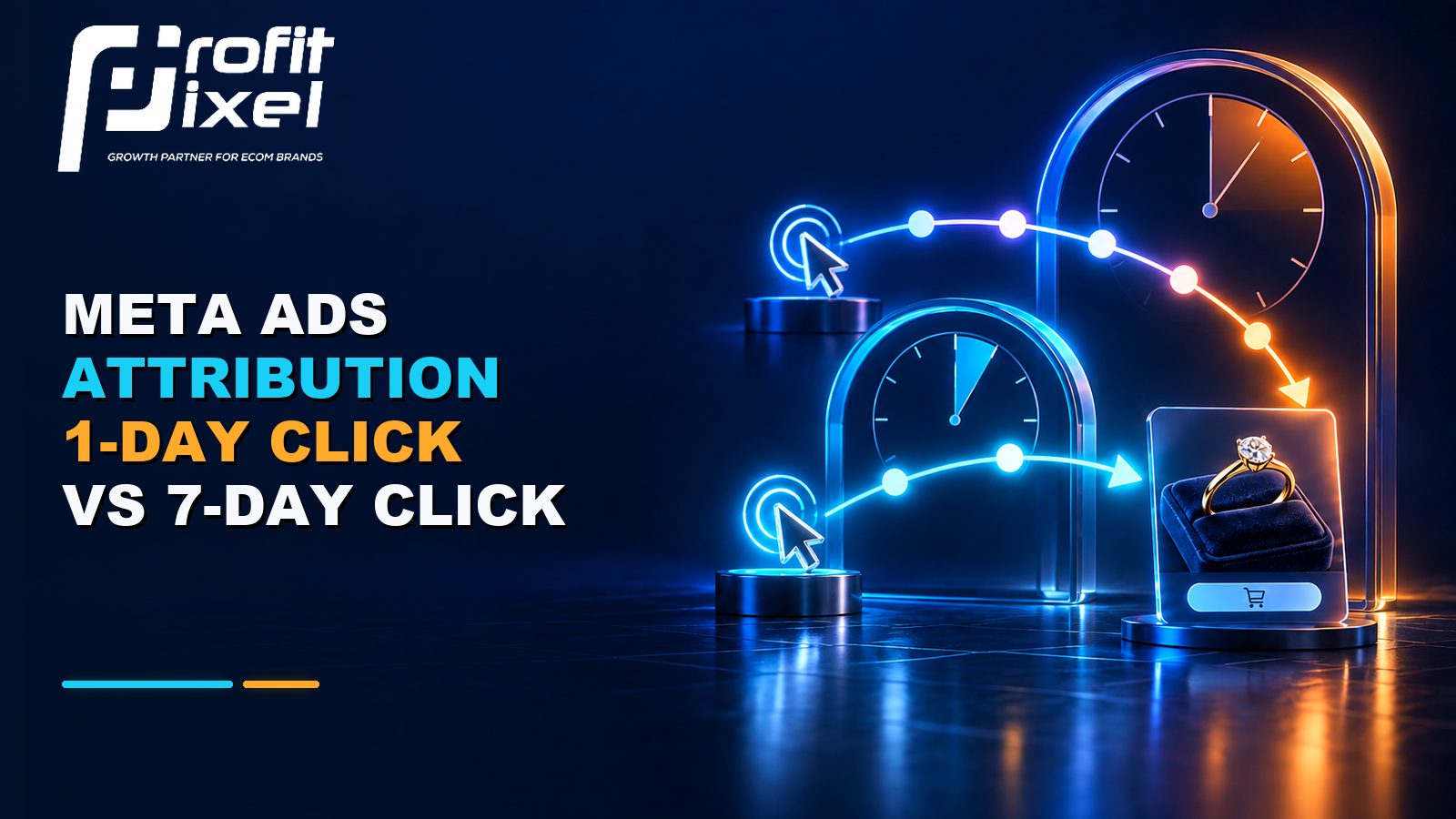

Attribution windows do not create sales. They change which sales Meta can claim and which signals its delivery system can use for reporting and optimisation.
Two advertisers can generate the same real orders and report different Meta ROAS because they use different attribution settings. That is why an attribution window should never be treated as a cosmetic reporting toggle. It defines how long after an ad interaction a conversion can receive credit under the selected rule.
The exact controls available in Ads Manager can change, and view-through options may also affect reported results. Always confirm the setting shown in the current interface. The durable principle is to understand what is being counted and keep comparisons consistent.
What 1-Day Click and 7-Day Click Mean
| Setting | A Conversion Can Be Credited When | Typical Effect |
| 1-day click | The purchase occurs within one day of an eligible ad click | More conservative view of fast post-click response |
| 7-day click | The purchase occurs within seven days of an eligible ad click | Captures more delayed consideration and often reports more conversions |
Attribution does not prove that every credited order was caused solely by the ad. It applies the platform’s rules to observed interactions and events. A seven-day window has more opportunity to claim delayed conversions than a one-day window, but that does not automatically make it dishonest or more accurate.
How the Window Affects Optimisation
Meta does not use the setting only to display a report. Attribution and optimisation are connected: the system learns from conversions that qualify under the selected setup. A shorter window emphasises people likely to convert quickly. A longer window gives the system more delayed outcomes from which to learn.
Changing the setting can therefore change both the reported total and the delivery pattern. Avoid switching windows simply to make ROAS look better. Choose a business logic, document it and compare campaigns on the same basis.
When 1-Day Click Is Useful
- The buying decision is genuinely fast, and the product requires little consideration.
- The team wants a stricter view of immediate post-click demand.
- Promotions or inventory windows are short.
- Incrementality concerns are great, and the business wants to reduce credit for delayed conversions influenced by several channels.
- Conversion volume remains sufficient for stable optimisation and decisions.
A one-day window can be a useful pressure test, but it is not automatically the truth. It may under-credit an ad that introduced a product today and contributed to a considered purchase three days later.
When 7-Day Click Is Useful
- The product has a longer research or consideration cycle.
- Average order value is high enough that buyers compare, discuss or return later.
- The account needs more conversion feedback for delivery and optimisation.
- Historical reporting and planning already use a seven-day click basis.
- Backend analysis shows a meaningful share of orders arrive several days after the first paid-social visit.
Do Not Compare Unlike Windows
If one campaign reports on one-day clicks and another on seven-day clicks, the headline cost per purchase and ROAS are not directly comparable. The second campaign has a longer opportunity to receive credit. The same issue appears when an agency changes settings between reporting periods without restating the baseline.
- Keep the attribution setting visible in every performance report.
- Record the date of any change and avoid comparing the transition period as if nothing changed.
- Use Ads Manager’s comparison views, when available, to inspect how results change by window.
- Reconcile with store orders, new-customer revenue and blended marketing efficiency.
Use the Customer Journey to Choose
- Measure time from first paid-social visit to purchase in analytics or order-level data.
- Separate first-time buyers from returning customers; repeat buyers may convert faster.
- Review the distribution, not just the average. A few very late orders can distort the mean.
- Check whether a shorter window leaves the campaign with too few optimisation events.
- Select the window that reflects the decision cycle and supports stable delivery.
- Keep an independent business view so platform attribution never becomes the only source of truth.
A Practical Reporting Stack
| View | Purpose | Question Answered |
| Meta attributed | Campaign and creative optimisation | What did Meta credit under the selected window? |
| Store or CRM | Order and customer truth | What revenue, refunds and new customers actually occurred? |
| Blended | Executive budget control | How efficiently did total marketing produce total revenue? |
| Incrementality test | Causal measurement | What additional outcome happened because advertising ran? |
Frequently Asked Questions
Does 7-day click inflate Meta ROAS?
It generally allows more conversions to be credited than a one-day click window. Whether that overstates business impact depends on the customer journey and channel overlap. Validate it against backend and incrementality evidence.
Should every ecommerce brand use the same attribution window?
No. Buying cycle, order value, conversion volume and reporting needs differ. Consistency and reconciliation matter more than copying a universal setting.
Will changing the window change past store sales?
No. The orders do not change. The platform’s eligible credit and optimisation inputs change, which can alter reported performance and future delivery.
Make Attribution Useful for Decisions
ProfitPixel aligns Meta reporting with store revenue, customer type and contribution so your team can scale on a consistent measurement standard.